Stayinto · Administrative region
Troms og Finnmark
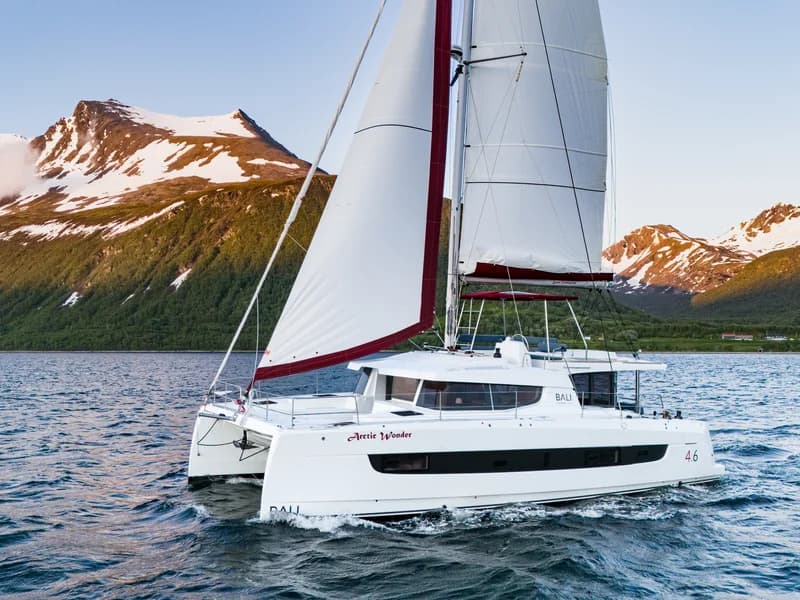
Pewter water lies flat beneath the Lyngen Alps, and their snowfields run almost down to the shore. Here, at the top of Norway, mountain, fjord and open sea meet in a single unbroken view.
Troms og Finnmark
Troms og Finnmark does not change gradually. Tromsø sits on its island with the feel of a university town, all wool shops and cafés, with the white triangle of its Arctic cathedral rising above the rooftops. Move north and west and the land thins out. Senja lifts into sharp, saw-toothed ridges above beaches of pale sand, while the Alta river has cut a deep gorge through the hills, its carved rock panels pressed into the ground for thousands of years. Further east the trees give up altogether. The Finnmark plateau is a flat, lichen-coloured expanse broken by lakes and reindeer tracks, and the wind crosses it without obstruction until it reaches the cliffs. Each stretch feels like a different country, yet all of it answers to the same long light and the same cold sea.
A day here takes its rhythm from the water. In Tromsø you can climb the hill above the town, look down over the roofs and the bridge, then walk to the harbour where fishing boats unload and the smell of diesel and salt hangs in the air. Head north and the road bends around the fjords of Kvaløya and Senja, stopping wherever a turning opens onto grey shingle. In Finnmark the place names grow stranger. Vardø, once a fishing port with a fortress on its headland, holds a memorial by the sea built from long wooden walls and quiet corridors, where the wind strikes the windows and little else disturbs you. Honningsvåg lies at the foot of Magerøya, and from the North Cape plateau the cliffs drop away in layers toward a horizon that looks entirely open. Kirkenes, at the eastern end, ends the road where the Russian border begins, a reminder of how far this county reaches. Dried cod still hangs on wooden racks along the shore, stiff and pale in the wind.
What stays with you is not any single sight but the sense of having reached an edge that is also a centre of its own. Evening arrives slowly, the mountains going blue and then a deeper violet, and the sea keeps its own quiet beside the harbour lights. You begin to understand why people who live here speak of the north with pride rather than apology. Leaving feels less like departure than like being released by a place that has no wish to be hurried. The coast, the fjords and the open tundra remain in your mind, and you find yourself already wanting another day of them.