Greece
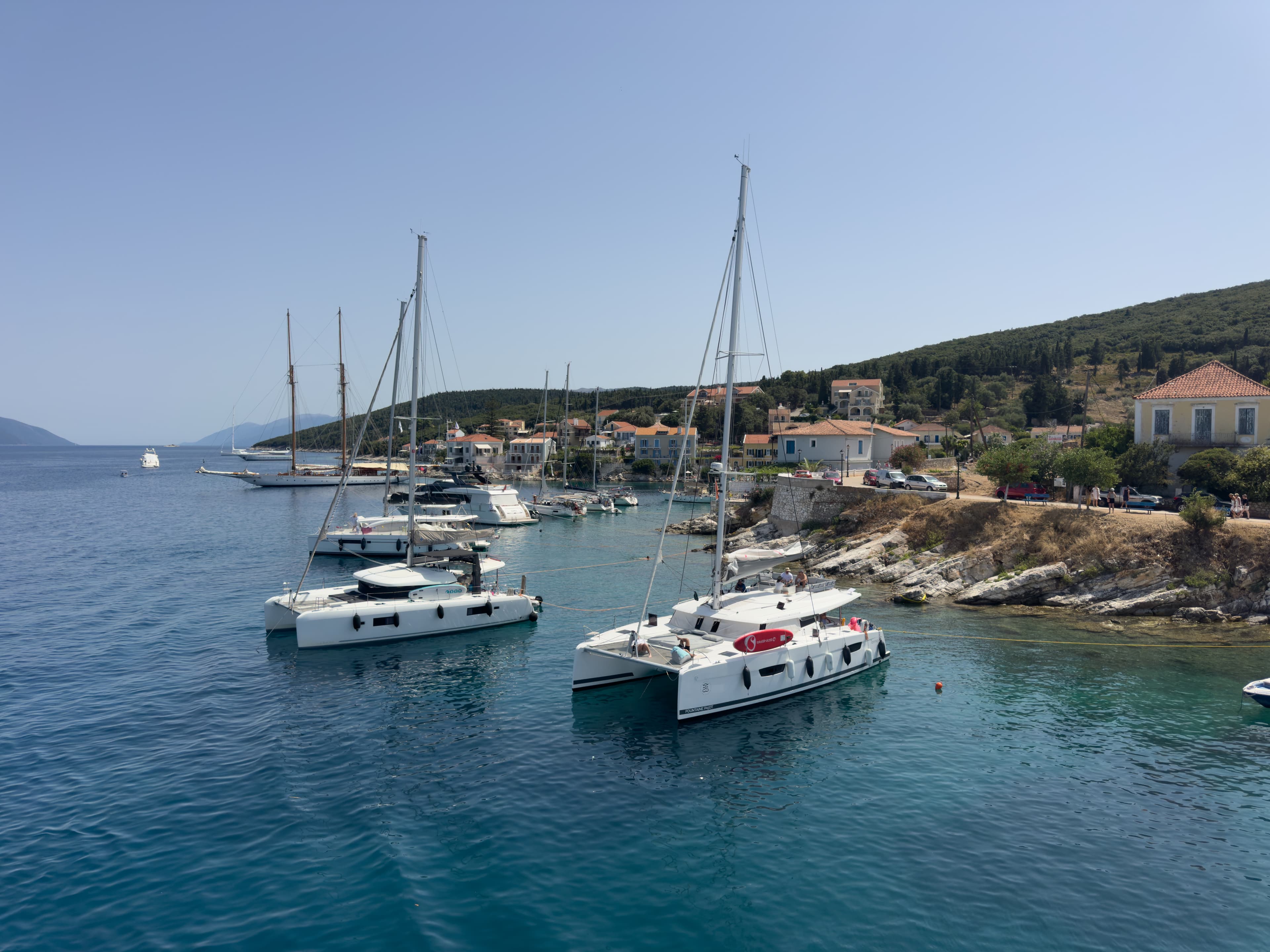
The coast around Fiskardo lies in the Ionian Islands of Greece, where green hills drop toward a sea that changes colour with every shift of light. Skippers who arrive here tend to slow down, because the water is calm enough to read and the shoreline rewards every hour spent watching it. Islands rise one after another across the horizon, each offering its own anchorage, cove, and view back toward the mainland. It is the kind of coast one wants to sail slowly, with the sails half up and no particular deadline.
Discover FiskardoOchre and cream house fronts stand shoulder to shoulder around a small harbour, their shutters painted green and blue against the glare. Fiskardo is the village at the northern tip of Kefalonia that the 1953 earthquake spared, so its waterfront still carries the Venetian shape that the rest of the island lost.
The place is best understood on foot, and early. Before the coaches arrive from the south, the lanes behind the quay hold a cool blue shadow, and the only sounds are a bucket on a stone step, a cat crossing a whitewashed sill, and the slap of small wooden boats knocking against the harbour wall. Light comes off the water and up under the eaves, so the facades look lit from below. Through the day the houses turn from pale to honey, and the paving stones give back the heat until dusk. Evening is slower still. Tables are carried out onto the quay, bread is set down beside bottles of local wine, and the harbour lights come on one by one above the water. Nobody hurries here. The village is small enough that a walk to the far end and back takes less time than a long lunch, and most people end up making the walk several times.
What gives Fiskardo its character is the way its streets meet the sea. The harbour is a working one, not a stage set: fishing caïques are tied up along the front, nets dry over rails, and the men who mend them sit on upturned crates and talk across the water. The old church sits a little above the quay, its bell catching the sun, and from its steps the bay opens out in layers of green and turquoise over pale sand. Beyond the village the road runs north along the coast to the headland, where a lighthouse stands above the rocks and the sea changes colour with every shift of cloud. Walking out past the last houses, you can take a path over the ridge to the small shore at Emblisi, where the water is clear enough to see the pebbles on the bottom and the pine trees come down almost to the edge of the sand. That shore is part of the same landscape as the harbour. Fiskardo's life depends on the sea, and the sea shapes what gets built, eaten, and talked about here.
The village keeps its own quarters and small rituals. Lanes behind the main front lead to gardens hung with bougainvillea and to courtyards where old women sit in doorways shelling beans. The bakery opens early and the smell of bread drifts down toward the water. In the afternoons the quay empties, and the houses look even more like a painted row set down on a Venetian canvas, their reflections trembling in the still harbour. These are the details that make Fiskardo feel lived in rather than arranged for visitors, and they are the reason people who arrive for a single afternoon often find themselves still there at sunset.
Leaving is harder than arriving. The last view from the headland road shows the whole curve of the village set against the hills, the church tower and the lighthouse marking its two ends, and the sea running off in every direction. What stays is not a list of things seen but the rhythm of the place: cool mornings, warm stone, a glass of wine on the quay as the light goes, and the sound of water against the harbour wall. Fiskardo asks only that you stay long enough to hear it.
Averages 2016-2025
11°
Jan
11°
Feb
13°
Mar
16°
Apr
19°
May
24°
Jun
27°
Jul
27°
Aug
24°
Sep
20°
Oct
16°
Nov
13°
Dec
Jun – Aug
26°
Sea 26°
Dec – Feb
12°
Sea 17°