

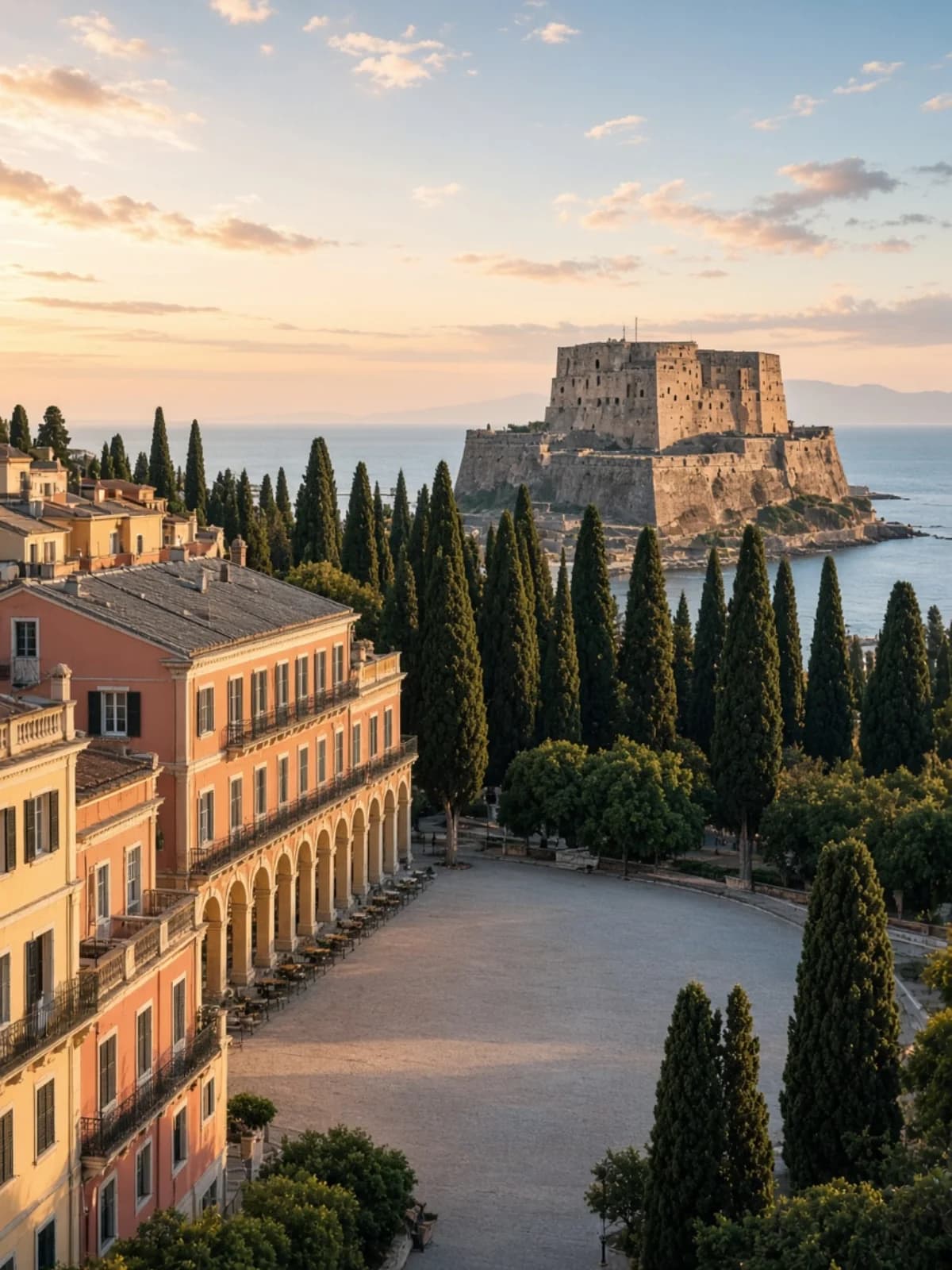

Old town of Corfu
Monumento
Stayinto · Regione amministrativa
Calcareous cliffs drop straight into water so clear that the seabed looks near enough to touch from a rowing boat. Across the Ionian Islands, green hillsides hang over that sea, and in the late light the rock turns the colour of honey.
The region is not one place but a sequence of distinct characters. Corfu, the northernmost, is the greenest and most layered. Its old town carries the marks of centuries of Venetian rule, with arcaded streets and church bell towers rising above shuttered houses. Further south, Lefkada is joined to the mainland by a causeway and feels more settled, its eastern shore lined with olive groves and reed-edged inlets. Kefalonia is larger and more rugged, its mountains pressing close to the coast and its villages rebuilt after the 1953 earthquake flattened much of the island. Ithaca is narrower and quieter, a long ridge of scrub and terraces where the pace slows to match the walking paths. Paxos and its smaller neighbours are the most intimate, with olive trees reaching down to tiny harbours and a sense that land and sea have agreed on a modest arrangement.
A day here tends to begin slowly. In the morning, bread from a village bakery is eaten on a harbour wall while fishing boats are unloaded, and the first coffee is taken under a plane tree whose shade has not yet been claimed by anyone. Towns such as Gaios on Paxos or Fiskardo on Kefalonia are small enough to walk in an hour, yet each has its own rhythm: fishermen mending nets, children diving off the mole, and a waterfront that gathers in the evening when the light softens and the hills behind turn violet. Inland, the roads wind through terraced fields, stone walls and cypress, and a stop at a village square can mean a glass of local wine poured without much ceremony. The coast is where the day is measured. You swim wherever the water is clearest, dry off on warm pebbles, and then eat grilled fish with lemon and oil, watching the boats come back into port.
What stays with visitors is less a single view than the way the region holds its people and its landscape together. The Ionian Islands are not dramatic in the way of high mountains or vast deserts; their pleasures are close and textured, measured in the smell of thyme on a path, the sound of waves against a stone jetty, and the slow dimming of the sea as evening comes on. Leaving is usually easier to contemplate than it proves to be. Most people find themselves thinking about another morning on the same harbour wall, another swim before the heat settles, another evening walk along the water's edge, and about how long they might let those mornings and evenings run.
Monumento